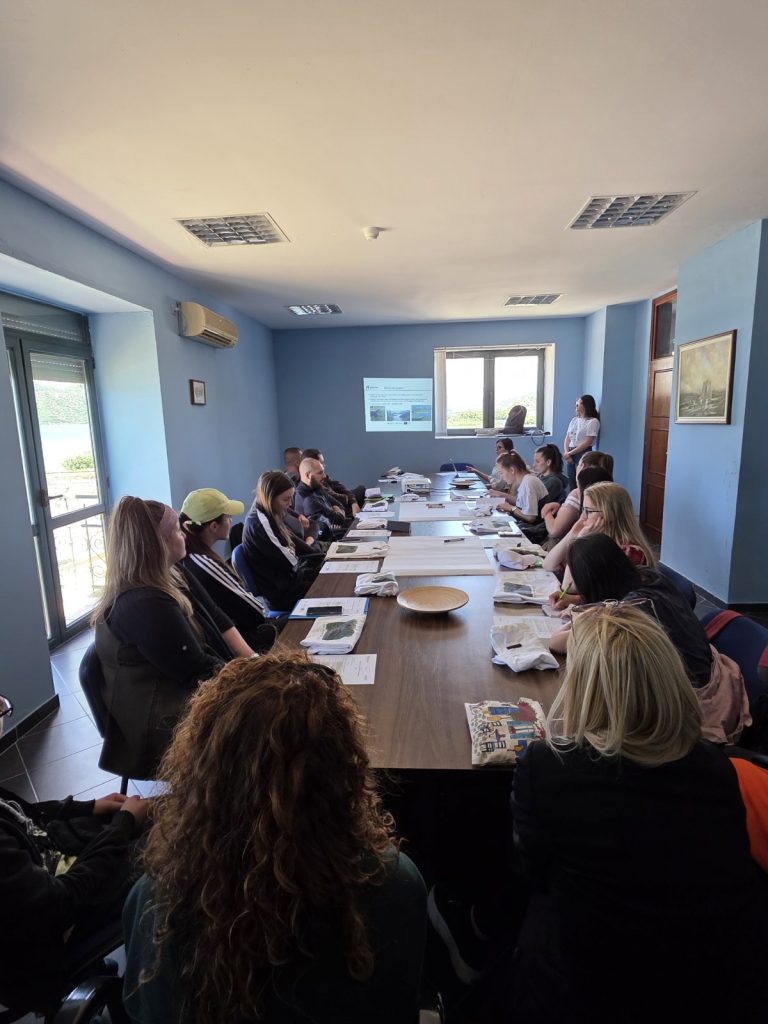
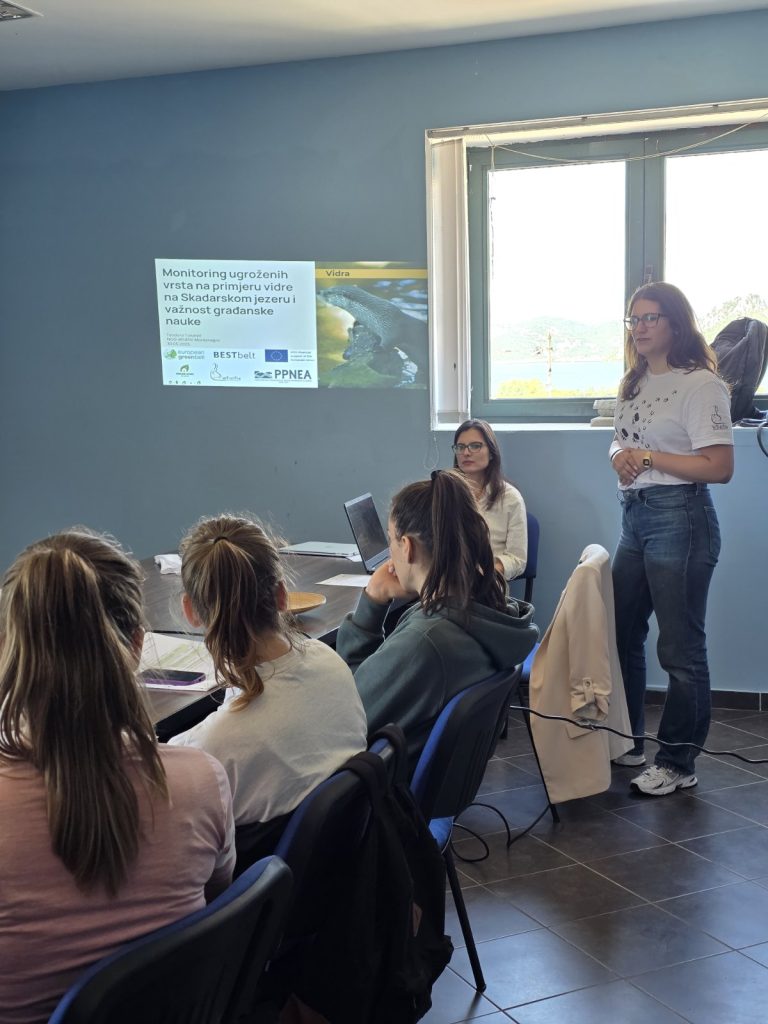
On Friday (23 May 2025), the NGO Green Home organized an educational training dedicated to the protection of endangered species and their habitats at Lake Skadar, with a special focus on the otter. The training was intended for the local community, students, and young researchers, providing them with an opportunity to learn about the causes of this species’ endangerment, the impact of human activities, and the ways in which each of us can contribute to biodiversity conservation.
The otter (Lutra lutra) is a semi-aquatic mammal from the mustelid family and one of the most important indicators of healthy aquatic ecosystems. This shy and rarely seen animal is perfectly adapted to life in water, with an elongated body, webbed feet, and a strong tail used for steering and propulsion. Its fur is extremely dense and waterproof, with up to 140,000 hairs per square centimeter. Although it often remains unnoticed, the presence of otters can be identified through their tracks and characteristic spraint, which they leave along the banks to mark their territory. Their diet is dominated by fish, but they also consume crustaceans, amphibians, birds, and small mammals. As an apex predator, the otter plays a key ecological role by regulating the populations of other species and contributing to the balance of freshwater ecosystems.
In Montenegro, otters are present throughout the country, especially in the river systems of the north and within the Lake Skadar basin. Despite legal protection, the species remains threatened due to habitat loss, water pollution, and various human pressures. According to the IUCN Red List, it is classified as Near Threatened, with a declining population trend. Otters are not competitors to fishermen — they are allies of nature. Where otters thrive, fish thrive too. Protecting their habitat means protecting the health of our waters and the life around them.
A special part of the workshop was dedicated to citizen science, highlighting ways in which local people can contribute to collecting valuable data for monitoring endangered species. During this session, the iMammalia app was presented, and participants were encouraged to use it actively.
As part of the project, monitoring of otter (Lutra lutra) activity was carried out in the Lake Skadar area in both Montenegro and Albania. This provided insights into the level of their presence and activity across the cross-border region of Lake Skadar. Participants had the opportunity to learn about otter research methodology and, through practical field exercises, gain hands-on experience with monitoring equipment. In this way, young researchers were particularly motivated to take part in future research and to contribute to habitat preservation and otter conservation.
The training was held at the Center on Vranjina as part of the project Improving the Status of the Otter (Lutra lutra) and Its Habitat in the Cross-border Area of Skadar Lake National Park, implemented by Green Home in cooperation with partners Wildlife Montenegro and PPNEA from Albania.
The project is supported by the European Union through the BestBelt program.